
Heavy mortar shelling and firing by Pakistani troops continued unabated along the International Border in Jammu and Kashmir on Wednesday killing two more people -- both women -- even as a "massive" reply was being given from the Indian side.

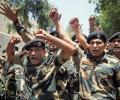
Media sources identified the soldiers, who belonged to the 21 Bihar Unit, as Naik Prem Nath Singh, Lance Naik Shambhu Saran Ray, Vyay Kumar Ray, Raghunandan Prasad and Naik Pundalik Mane

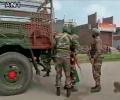
Terrorists on Monday night killed seven Amarnath pilgrims, including six women, and injured 19 others as they struck at a bus in Kashmir's Anantnag district, in the worst attack on the annual pilgrimage since the year 2001. Five of those killed were from Gujarat and two from Maharashtra. Here are the latest updates:
.jpg)
Throughout a quarter century of proxy war, India has shown tremendous restraint in the face of grave provocation. It is inconceivable that any other nation would have refrained from launching trans-LoC operations to eliminate terrorist training camps and interdict known routes of infiltration, says Brigadier Gurmeet Kanwal (retd).

Ceasefire violations by Pakistan Rangers continued on Thursday with 60 Indian border outposts and over 80 villages coming under mortar shelling and firing in Jammu, Samba and Kathua districts along the International Border.
This is the second major ceasefire violation along the IB this month and came despite Director General Military Operations of the two countries agreeing, on May 29, to implement the ceasefire pact of 2003 in "letter and spirit".
"The timing of the attack, methodology and location are all eerily similar to attacks in the border belt of Jammu," said Abdullah.
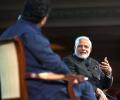
'From the evidently pre-selected questions to the promotional slides on a screen redolent of the official audio-visual department, the choreography was palpably intended to present the prime minister in as good a light as possible in a 'safe' environment insulated from uncomfortable questions,' says Amulya Ganguli.
'India's policy makers need to pull their heads out of the sand and recognize the reality that Pakistan has supported and sponsored terrorism on Indian soil for more than three decades; a national counter-terrorism strategy must be evolved in the fullest consciousness of this fact, and of the continued hostility of the Pakistani nation-State to the very idea of India.'

'The people of the state can be won over by love, and not by swords.'

'Local support is very important, without it the terror attack couldn't have taken place.' 'Explosives were secured, the IED was manufactured, the boy was brainwashed and converted into a suicide bomber... it takes a lot of planning and hard work.'

Cheap milk prices, rising fodder cost and the difficulties in buying new cattle and selling old ones on account of cow vigilantism have cast a triple shadow on this sunshine sector in Indian agriculture, reports Sanjeeb Mukherjee.

'She has to get the funds, cut through bureaucratic flab, speed up modernisation, ensure planned acquisitions stick to timelines, make organisational changes and ensure the military is capable of performing the task that it is given,' says Brigadier S K Chatterjee (retd).

'It is this new brand of nationalism, where the saffron has elbowed out the other shades in our Tiranga, that will go before the electorate later this year.' 'And it is this new nationalism that will power Modi back into office with 300-plus seats when elections are held,' says Saisuresh Sivaswamy.
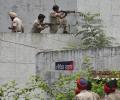
Seven people, including two police officers and a terrorist, were killed as the Punjab Police's elite Special Weapons and Tactics team and the Indian Army were carrying out a massive operation in the Gurdaspur district to flush out terrorists who went on a rampage attacking a bus and a police station complex.
